More Than Brown: Reading the Chemistry of Soil Through Color
 Dr. Rosalie Sinclair

What a watercolor palette can teach us about minerals, water, microbes, and the living world beneath our feet.
I have spent a lot of time thinking about brown lately. Or, more accurately, about how little of the world beneath our feet is actually brown.
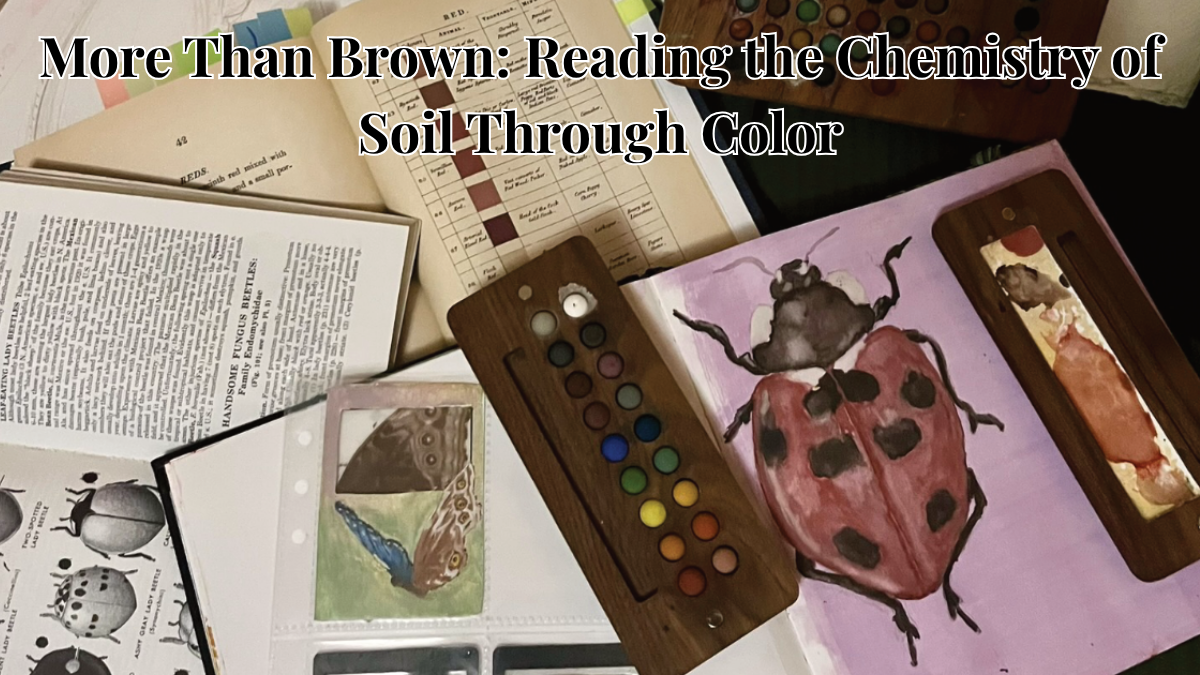
The thought began at my desk while swatching a set of watercolors made entirely from real soil. You touch a wet brush to a little pan of dried earth, sweep it across watercolor paper, and suddenly something easily dismissed as “dirt” blooms into warm ochres, fiery rusts, soft yellows, deep espresso browns, and quiet, slate grays.
Before diving into the science, it is worth making a friendly distinction.
Soil, not dirt
In everyday conversation, we use soil and dirt interchangeably. In soil science, though, soil means something much richer than the everyday word dirt suggests.
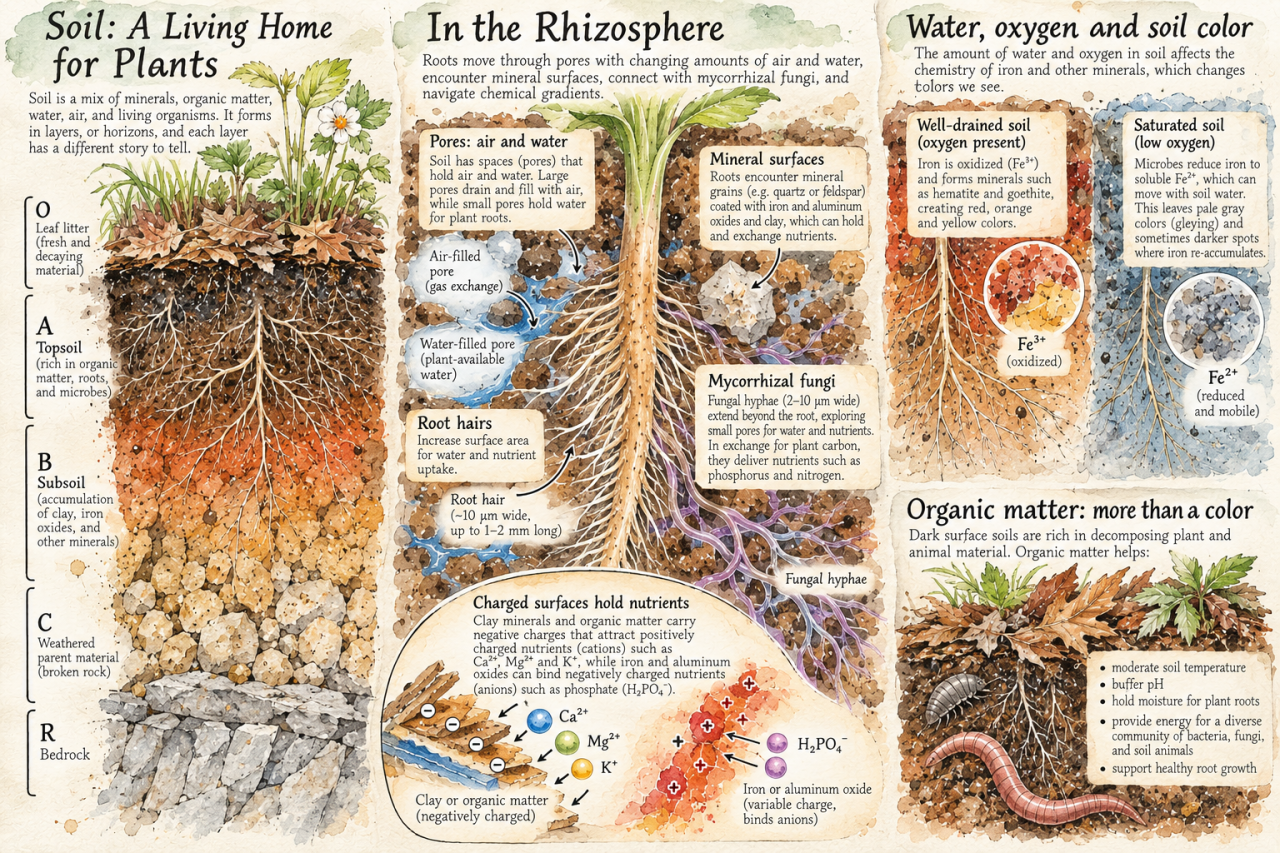
Soil is a living, organized ecosystem. It is built over centuries by interactions between weathered rock, decaying plants, living creatures, rainfall, changing temperatures, and landscape slopes. If you dig down into the ground, you will find soil neatly organized into distinct, beautiful layers called horizons.
A single handful of healthy garden soil is also teeming with life, containing billions of bacteria, delicate networks of fungal threads, microscopic nematodes, earthworms, and plant roots. All of these organisms work together to cycle nutrients, build soil structure, and create the underground architecture that keeps plants fed and hydrated.
“Dirt,” on the other hand, is a wonderfully useful everyday word. It is what we tend to call soil when it ends up where we do not want it: tracked across the kitchen floor, wedged under our fingernails, or staining the knees of our favorite jeans.
Dirt is what we sweep up. Soil is a living home.
A paint palette is already a chemistry experiment
Before looking out at the landscape, look at the paint box sitting on the desk.
It is easy to think of an art store as a place organized purely by color. We see neat rows of tubes with lovely names like Raw Sienna or Yellow Ochre. Chemically, though, every paint shelf is a materials science laboratory.
Paint brings together colored powder, known as pigment, with a sticky binder. Color begins with the way matter interacts with light. The wavelengths a pigment absorbs and reflects depend on its chemical composition and structure.
Tyler Thrasher and Terry Mudge explore this idea in The Universe in 100 Colors, showing how color serves as an open doorway into physics, chemistry, and biology. Once you start asking why something is a certain color, a surprising amount of science follows.
When you paint with soil watercolors, the boundary between an artist’s studio and the earth beneath our feet disappears completely.
What color is soil?
If you ask someone to imagine soil, they will almost always picture plain brown.
There is nothing wrong with that answer because plenty of topsoil is brown. But the fun begins when you look closer.
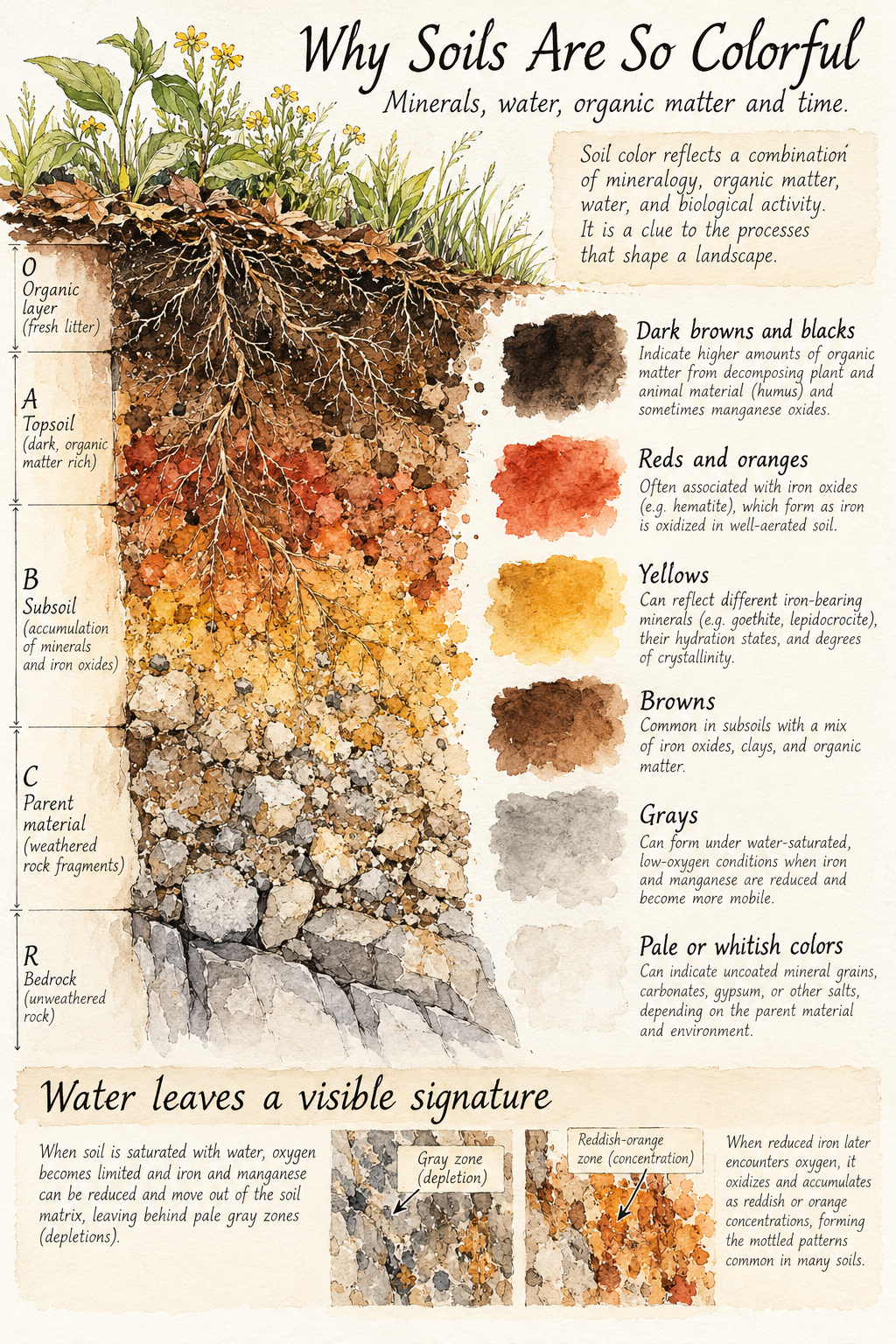
Dig down a few feet, and the earth can reveal brick reds, bright ochres, charcoal blacks, and ghostly pale grays.
To a soil scientist, these colors are never just decorative. They are environmental clues. A soil’s color tells the story of its parent rock, how much rain it receives, whether water drains away or pools in place, and how much biological activity has occurred there over thousands of years.
And among all the ingredients painting the underground world, one element does the heavy lifting: iron.
Reds, yellows, and the chemistry of iron
Iron is everywhere in the earth's crust. As solid rock weathers and crumbles over geological time, iron is released and forms tiny mineral coatings on surrounding sand and silt grains.
Even a microscopic coating of iron can completely transform the color of an entire landscape:
- Hematite (Fe₂O₃): Often contributes red and terracotta colors to soils.
- Goethite (FeO(OH)): Often contributes yellow, ochre, and yellow-brown colors.
Which iron minerals form and persist depends on a mixture of moisture, temperature, oxygen, pH, weathering history, and other soil conditions.
This explains our classic warm earth pigments. But what happens when you soak that soil in water?
When water changes the palette
A tiny pore between two soil grains might seem small, but it acts like a microscopic chemistry lab.
When soil is well-drained, fresh air moves freely through those pores, keeping iron fully oxidized in its insoluble ferric Fe³⁺ state. But when heavy rain or a high water table saturates the ground, water fills those pore spaces and oxygen becomes much less available.
Soil microbes still need to metabolize to survive. Once all the free oxygen is used up, resourceful microbes turn to iron instead, chemically reducing it from insoluble Fe³⁺ into soluble Fe²⁺.
Once dissolved, the iron can actually wash away with moving water. If it later hits a pocket of fresh air, it oxidizes and locks back into place.
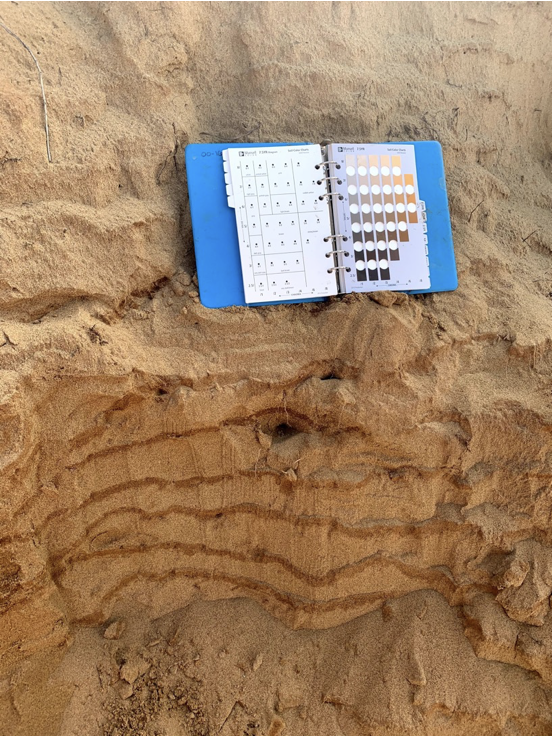
This underground chemistry leaves behind visible patterns called redox features:
- Gray zones (depletions): Spots stripped of their iron coatings, exposing the quiet gray color of bare mineral grains.
- Orange and red zones (concentrations): Bright, rusty spots where dissolved iron met oxygen and settled out.
This means iron can leave a lasting chemical trace: it shows us where water has stood and moved, long after the puddle itself has dried up.
Dark soil and the carbon story
Iron creates the warm rusts and yellows, but organic matter gives soil its rich depth.
Decomposing roots, fallen leaves, microbial remains, and other organic materials gradually become part of the soil's organic matter. These carbon-rich materials often darken the upper layers of soil. They can also help soil retain water and nutrients, support soil structure, and feed an enormous community of organisms.
When you see rich, dark earth, you may be seeing part of the long story of carbon moving from living organisms into soil.
Before cameras: How did you describe a color?
Translating color into reliable scientific data is an old problem.
Imagine you are a naturalist in 1814. You are exploring a distant forest and discover an unfamiliar flower, a rare bird, or an unusual rock. You need to describe its exact shade to a colleague
thousands of miles away. You cannot take a photo, send a digital file, or share a color code. And simply writing "brownish-yellow" could mean fifty different things to fifty different people.
To solve this, Scottish flower painter Patrick Syme published Werner’s Nomenclature of Colours in 1814.
Syme hand-painted 108 color swatches and linked every single one to three living examples: one from the Animal, one from the Vegetable, and one from the Mineral kingdom. A single standardized color became a bridge connecting a bird's wing, a dried seedpod, and a weathered stone. Charles Darwin even packed a copy in his trunk aboard the HMS Beagle to describe the wildlife he encountered on his travels.
Today, soil scientists solve the same basic problem with a different system: the Munsell Soil Color Charts. Instead of poetic names, field researchers match a moist soil clod to standardized color chips to record its Hue (spectral family), Value (lightness), and Chroma (intensity). This gives it an exact code like 10YR 4/3 that scientists can consistently recognize and compare.
Whether it is an 1814 naturalist with a pocket guide, a field pedologist with a Munsell chart, or an artist swatching a watercolor pan, they are all doing the same fundamental thing: slowing down, observing closely, and trying to communicate the physical truth of what they see.
How color leads back to plant roots
As a plant biologist, this is where the art and the science meet for me.
A plant root never experiences a simple block of "brown dirt." It navigates a complex, three-dimensional underground world.
It pushes through pores filled with shifting balances of air and moisture, touches mineral faces carrying electrical charges, teams up with mycorrhizal fungi to search for water, and navigates microscopic pockets of oxygen.
The colors we see in a soil core are a direct map of that underground experience: geology, water flow, microbial respiration, and root growth, all recorded in physical layers.
Back to the palette
Collectively, this is why swatching handmade soil watercolors is so special.
At first, it is just calming. The brush meets paper, and pigments bloom and settle into the grain of the page.
Then scientific curiosity takes over.
A stroke of yellow ochre is an encounter with weathered iron. A dark umber wash is an inquiry into carbon storage and microbial life. A pale gray line is a whisper of ancient puddles and electron transfers.
The palette becomes a landscape. The landscape becomes chemistry. And the chemistry brings us right back to life.
The next time you look down at the ground, look past the generic brown. Look for the rusts, the golds, the grays, and the deep charcoals. The earth is telling a story, and we just have to learn how to read its colors.
6ac415ea71548_lg.png)
Getty Conservation Institute. (n.d.-a). Binding media. J. Paul Getty Trust. https://www.getty.edu/projects...
Getty Conservation Institute. (n.d.-b). Modern paints. J. Paul Getty Trust. https://www.getty.edu/projects...
Natural History Museum. (n.d.). Nature's colours: From page to paint. https://www.nhm.ac.uk/discover...
Natural Resources Conservation Service. (2015). Illustrated guide to soil taxonomy (Version 2.0). U.S. Department of Agriculture. https://www.nrcs.usda.gov/site...
Natural Resources Conservation Service. (2024). Field book for describing and sampling soils (Version 4.0). U.S. Department of Agriculture. https://www.nrcs.usda.gov/site...
Natural Resources Conservation Service. (n.d.-a). What is soil? U.S. Department of Agriculture. https://www.nrcs.usda.gov/reso...
Natural Resources Conservation Service. (n.d.-b). Soil biology primer. U.S. Department of Agriculture. https://www.nrcs.usda.gov/reso...
Natural Resources Conservation Service. (n.d.-c). Soil colors of the United States. U.S. Department of Agriculture. https://www.nrcs.usda.gov/reso...
Natural Resources Conservation Service. (n.d.-d). Soil health glossary. U.S. Department of Agriculture. https://www.nrcs.usda.gov/stat...
Natural Resources Conservation Service. (n.d.-e). Role of organic matter. U.S. Department of Agriculture. https://www.nrcs.usda.gov/cons...
Soil Survey Staff. (2022). Soil survey field and laboratory methods manual (Soil Survey Investigations Report No. 51, Version 2.0). U.S. Department of Agriculture, Natural Resources Conservation Service. https://www.nrcs.usda.gov/site...
Soil Survey Staff. (2024). Keys to soil taxonomy (13th ed.). U.S. Department of Agriculture, Natural Resources Conservation Service.
Syme, P. (1814). Werner's nomenclature of colours: With additions, arranged so as to render it highly useful to the arts and sciences, particularly zoology, botany, chemistry, mineralogy, and morbid anatomy. William Blackwood.
Thrasher, T., & Mudge, T. (2024). The universe in 100 colors: Weird and wondrous colors from science and nature. Sasquatch Books.
Vaughan, K. (n.d.). The Art of Soil. Retrieved October 5, 2026, from
https://theartofsoil.com/
Categories: : All, plant structure